Build an AI-native product
A product designed for AI from day one.
We help you build products designed from the start to leverage artificial intelligence.
Our method
From spec to maintenance, AI integrated at every step.
Scoping and spec
Identifying business constraints, audience, market, needs. Writing a spec that aligns every stakeholder.
Technology selection
State-of-the-art research on existing technologies (LLMs, NLP, OCR…) to propose the stack best matched to your situation.
Product development
Agile method, priority to features that maximise value — mobile or web, always user-centred.

Maintenance and iteration
Operational upkeep, analysis of effectiveness with users, continuous improvement recommendations.

Our MVP approach
To minimise your time-to-market.
Are you an entrepreneur with a product idea? A company or large group looking to launch a new offering? We help you build and launch your MVP in a few weeks.
The goal is to gather user feedback quickly and adapt your product to their needs — while cutting development costs through a method built for it.
Technologies we use
 Cloud
Cloud Front-end
 Backend / Android
 Database
 Performance
 Mobile
Our client successes
We build our own products. That's why we know how to build yours.

Designing an AI-native product means starting from the model's capability to redefine the experience — not sprinkling a chatbot onto an existing product. We partner with founders and product teams who want to build something that wouldn't exist without LLMs: autonomous agent, vertical assistant, business copilot. If AI is just a feature, our AI Integration service is more relevant. Here we're talking about products where model quality determines value.
Typical use cases
Vertical business copilot
Specialised assistant for legal, medical or accounting work — with a proprietary document base, domain vocabulary and embedded workflows.
Autonomous agent
Agent that orchestrates multiple tools (CRM, APIs, scraper) to execute a complex task end-to-end (lead qualification, report generation).
Generative platform
A product whose value is generating a structured deliverable: pitch deck, grant application, product sheet, contract.
Our method in brief
We start with a product scoping workshop centred on evaluation: what is the 'good answer' the model has to produce? We build an evaluation set (50-200 cases) before the first prompt — that's what drives every iteration. Then: prototype in 2-3 weeks with Claude/GPT, measure quality/cost, refine (prompts, RAG, targeted fine-tuning), then ship to production with observability. The method differs from classic dev: it's a product whose quality must be proven statistically, not just functionally.
Stack & technologies
LLMs: Claude 4 Opus / Sonnet first for reasoning quality, GPT-4o / o1 for tools, Mistral for European constraints. Self-hosted (Llama 3.3, Qwen 2.5) when GDPR is strict. Orchestration: LangGraph, Mastra. Evaluations: Braintrust, LangSmith, Promptfoo. Front-end: React + Vercel AI SDK with streaming. Vector DB: pgvector or Qdrant.
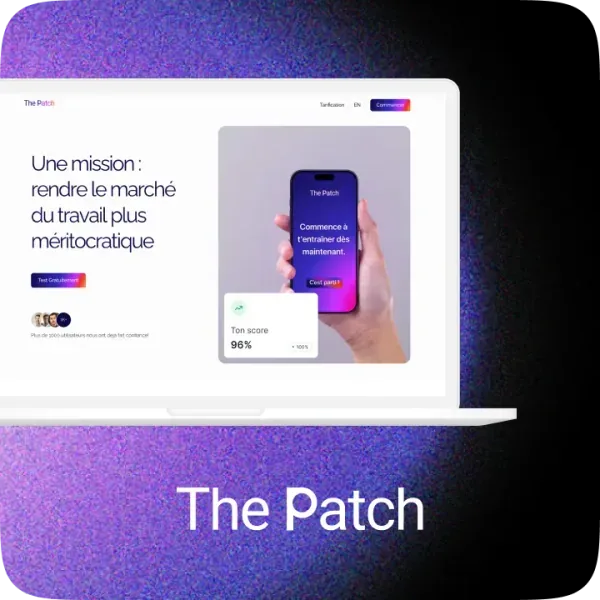
// Moriarty (2,000+ indexed public grants) and The Patch (AI interview simulator) — two AI-native products shipped in 2024
Frequently asked questions
Should the model be fine-tuned?+
Rarely before you've exhausted prompt engineering and RAG. Fine-tuning makes sense when you have 1,000+ labelled examples, a very specific output format, or a need to cut costs at scale. We recommend it explicitly when it's the right tool — not by default.
How is IP protected on prompts and the knowledge base?+
Prompts live in your repo, not at the LLM vendor. The Anthropic, OpenAI and Mistral APIs guarantee by default that no customer data is used for training. For GDPR-sensitive cases (health, named legal data), we switch to AWS Bedrock or self-hosted.
Do you offer fully open-source models?+
Yes — deploying Llama 3.3, Qwen 2.5 or Mistral Small via Together AI, Replicate or dedicated AWS/Scaleway infrastructure. Strong for extraction and classification, sometimes below Claude/GPT on complex reasoning. We benchmark on every project.
How long before quality can be measured?+
The evaluation set is built before the code. By the end of week 2, you have an automated quality score that updates on every deployment. It's the opposite of a traditional product where you discover bugs in production.
Got a project?
Nothing beats a conversation to shape the right solution together.